Equithermic regulation
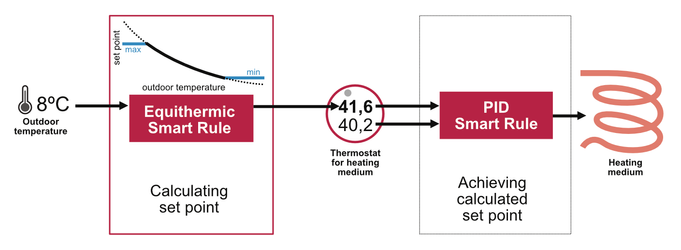
Equithermic regulation is a simple method for calculating the temperature of the heating or cooling medium in the primary circuit based on the outdoor temperature. In most cases, this function is controlled by the boiler or heat pump.
If the curve is configured correctly, it should be possible to achieve the desired temperature in zones with the lowest possible medium temperature (in heating mode) or the highest possible medium temperature (in cooling mode).
A drawback of this method is that it does not have a built-in automatic correction mechanism. If the equithermic curve is not set correctly, it can lead to insufficient or excessively intensive heating/cooling in the zones.
Heating and cooling control
| Aspect | Heating | Cooling |
|---|---|---|
| Inputs | - Outdoor temperature - Zone temperatures | - Outdoor temperature - Zone temperatures - Zone Humidity |
| Output | - Setpoint of the virtual thermostat for the primary circuit | - Setpoint of the virtual thermostat for the primary circuit |
| Limits | - Minimum / maximum configured value | - Minimum / maximum configured value - Dew point (early warning) - Calculation of the minimum setpoint based on the highest relative humidity from all connected zone thermostats |
| PID correction | ❌ | ❌ |
More information about heating/cooling modes
How the final setpoint is calculated
The equithermic curve returns the temperature of the circulating water based on the outdoor temperature. The curve angle, parallel shift, temperature limits, and adjustments based on thermostat data influence the final result.
Angle
For underfloor heating systems, values between 0.2 and 0.8 are commonly used. Lower values are more suitable for buildings with high-quality insulation. The following table shows the resulting setpoint based on outdoor temperature and the curve angle:
Outdoor temperature
| Angle | -20°C | -15°C | -10°C | -5°C | 0°C | 5°C | 10°C | 15°C | 20°C |
|---|---|---|---|---|---|---|---|---|---|
| 0.2 | 33 | 32 | 32 | 30 | 29 | 27 | 24 | 22 | 20 |
| 0.4 | 42 | 40 | 38 | 36 | 33 | 30 | 27 | 24 | 20 |
| 0.6 | 50 | 48 | 45 | 41 | 37 | 33 | 29 | 25 | 20 |
| 0.8 | 59 | 56 | 52 | 47 | 42 | 37 | 31 | 26 | 20 |
Example: If the outdoor temperature is 0°C and the equithermic curve angle is 0.6, the resulting setpoint is 37°C.
Parallel shift
Increases or decreases the curve by a defined value.
Example: If the temperature set based on the curve angle is 37°C and the parallel shift is set to 4°C, the resulting setpoint is 41°C.
Adjustments based on data from thermostats
All zone thermostats that are connected to the equithermic Assigned Smart rules affect the final result.
| Heating | Cooling | |
|---|---|---|
| Setpoint from zones | The equithermic curve shifts upward if the highest setpoint of zone thermostats is greater than 22°C | The equithermic curve shifts downward if the lowest setpoint of zone thermostats is less than 22°C |
| Result | Resulting setpoint = Setpoint based on angle and parallel shift + Proportional value * (highest thermostat setpoint - 22) | Resulting setpoint = Setpoint based on angle and parallel shift + Proportional value * (lowest thermostat setpoint - 22) |
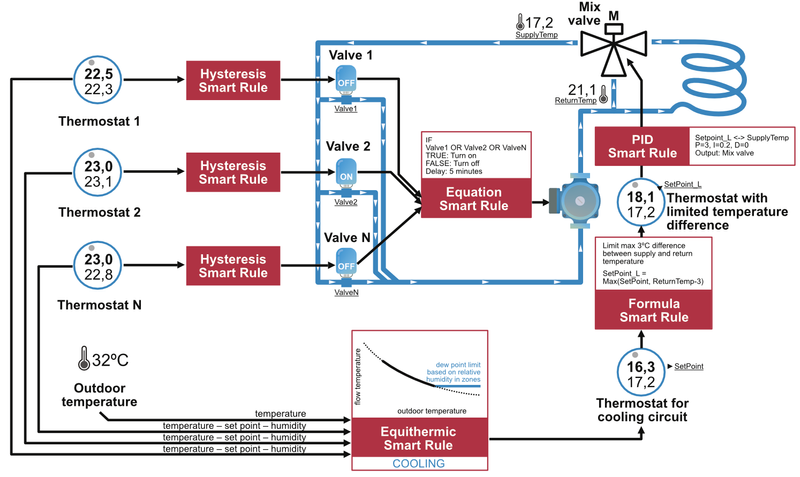
Example scenario for zoned hydronic heating with equithermic regulation
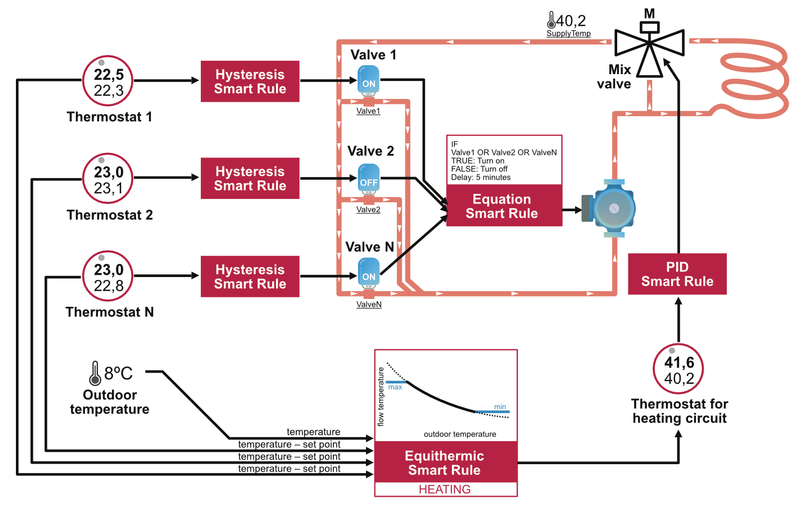
Example scenario for zoned hydronic cooling with equithermic regulation