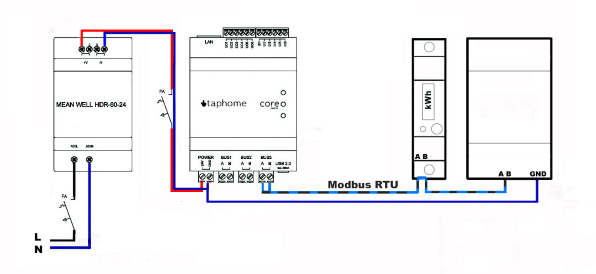
Examples of Modbus RTU cabling
For devices connected to the Modbus RTU line, different rules apply when connecting devices. Devices are connected using two A / B conductors.
Implementing a GND connection from a 24V DC power supply is not required. However, if devices require this connection according to the manufacturer’s specifications, this requirement should be implemented.
Device addressing
Since manufacturers typically configure their peripherals to address 1 by default, each device should be assigned a unique identification address in the range 1–250 when connecting them sequentially.
Devices with the same address in the system will not function.
Bus termination
The bus should be terminated with a 120R resistor. Some products already have this resistor built in; in that case, it does not need to be mounted on the connection terminals.
Types of devices
Devices that communicate via the Modbus RTU protocol are mostly heat recovery systems, air conditioning units, energy meters, relay output modules, and input modules.
Communication parameters
For proper Modbus communication, all peripherals must be configured with the same communication parameters: baud rate, parity, and number of stop bits.
Cabling requirements
For standard RS485 and Modbus RTU wiring used in industrial installations, a cable type that meets the EIA RS-485 requirements with an impedance of 120 Ω is specified.
To create a Modbus RTU bus with TapHome control blocks, it is possible to use cables such as Cat5E, Cat6, Cat6A, and others.
Cabling specifically certified for RS-485 networks is not required.
Also, shielded cabling is not strictly required, either overall or for individual pairs.
In cables that do not have individually shielded pairs, it is not recommended to run two different networks such as RS-485 and 100/1000 Mbit LAN, or other bus networks (EZS, EPS, Modbus RTU, etc.).
Wiring diagram