Optical Bus Isolation
The bus can also be separated with a bidirectional optical isolator. This provides full galvanic isolation between two power systems. The isolator is also equipped with basic Type D overvoltage protection, intended for RS-485 or Modbus bus data transmissions.
When to Use Optical Isolation
We recommend this type of isolation whenever the cabling is located in places where it could be mechanically damaged. This also creates the possibility of direct induction of voltages into the systems.
It’s useful to use the bus isolator:
- To amplify the signal – as a signal shaper on long buses
- In case of mechanical damage – when the cabling is in high‑risk locations
- In case of induction problems – where there is a risk of direct voltage induction
- In case of communication problems – where reverse voltage waveforms, interference, or reflections occur on the bus data cables for unknown reasons
Important Notice
The bus isolator does not fully provide overvoltage protection.
The bus isolator isolates the master and slave from each other, but does not reduce the induced voltage with respect to the PE/PEN terminal.
Connection Diagram
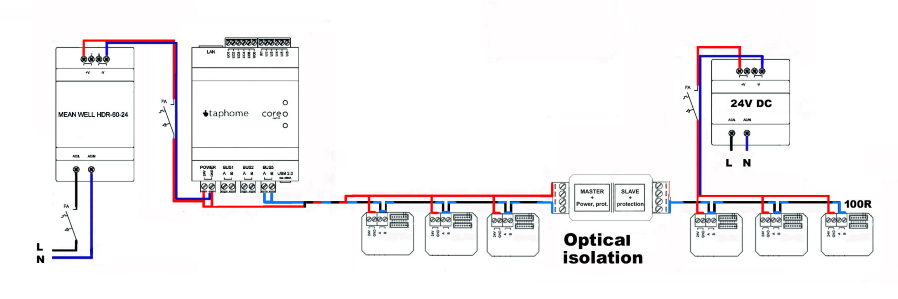
The diagram shows a separate line with two power sources and an optical isolator.
Technical Specifications
- Type of isolation: Galvanic optical isolation
- Overvoltage protection: Type D
- Supported protocols: RS-485, Modbus RTU
- Type of communication: Bidirectional
- Function: Power system isolation, signal shaping