
Boiler Cascade
Configuration and setup of cascade boiler systems to achieve desired hydraulic circuit temperature using PID controller.
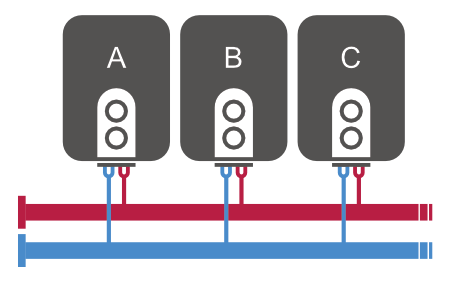
Use this setting to achieve the desired hydraulic circuit temperature using two or more boilers connected in cascade.
In the example scenario, we will show the configuration for 3 boilers that can be controlled by digital outputs.
Preparation
You should already have the following devices defined:
- Thermostat with return water temperature measurement on the pipe
Digital outputs for each boiler
- Boiler A
- Boiler B
- Boiler C
Virtual analog output
This output will be used as a variable to calculate the total heat output.
Basic configuration
Create a Smart Rule PID temperature controller that will calculate the total output based on the difference between the thermostat setpoint and the current temperature.
| Input device | → Smart Rule → | Output device |
|---|---|---|
| Thermostat | → PID Controller → P = 2, I = 0.2, D = 0 | Total output |
Based on the range of the total output, 3 (or more) boilers will be turned on.
Configuration for the mode where boiler priority is: Boiler A → Boiler B → Boiler C
| Input device | → Smart Rule → Equation | Output device |
|---|---|---|
| <1% | – | – |
| >1% | If the total output > 0.01 Minimum duration: 5 min TRUE: Turn on Boiler A FALSE: Turn off Boiler A | Boiler A |
| >45% | If the total output > 0.45 Minimum duration: 5 min | Boiler B |
| >90% | If the total output > 0.90 Minimum duration: 5 min | Boiler C |
Boiler rotation
To ensure even use of the boilers, additional configuration is required.
Creating a multi-valued switch
Define N+1 states, where N is the number of boilers.
The last state can be defined as Heating inactive, which means the system is not heating.
Name: Boiler Priority
States:
- Priority A (Boiler A → Boiler B → Boiler C)
- Priority B (Boiler B → Boiler C → Boiler A)
- Priority C (Boiler C → Boiler A → Boiler B)
- Heating inactive
Creating a Smart Rule sequencer
This sequencer will rotate priorities as follows:
A → B → C → A → …
| Input device | → Smart Rule → | Output device |
|---|---|---|
| Virtual button to start the sequencer | Sequencer | Boiler priority |
| Step 1: Priority A (duration: 18 hours) | ||
| Step 2: Priority B (duration: 18 hours) | ||
| Step 3: Priority C (duration: 18 hours) | ||
| ✅ Rotate sequence |
Define a separate set of Smart Rule rules restricted to each boiler priority.
See Smart Rules for Priority A in the table below:
| Input device | → Smart Rule → Equation | Output device | Restricting condition |
|---|---|---|---|
| <1% | – | – | – |
| >1% | If the total output > 0.01 TRUE: Turn on Boiler A FALSE: Turn off Boiler A | Boiler A | Type: Multi-valued switch Rule only applies when Boiler Priority is set to Priority A |
| >45% | If the total output > 0.45 TRUE: Turn on Boiler B FALSE: Turn off Boiler B | Boiler B | Type: Multi-valued switch Rule only applies when Boiler Priority is set to Priority A |
| >90% | If the total output > 0.90 TRUE: Turn on Boiler C FALSE: Turn off Boiler C | Boiler C | Type: Multi-valued switch Rule only applies when Boiler Priority is set to Priority A |
A similar set of Smart Rule rules should be applied with a restricting condition for Priority B and Priority C.