
Documentation
PID Cascade Regulation
Increasing heating system stability using two interconnected PID Smart rules for underfloor heating control.
If the temperature of the heating element is measured, it is possible to increase the stability of the heating system using two interconnected PID Smart rules (so-called cascade PID control).
Comparison with simple hysteresis control:
| Cascade PID control | Hysteresis |
|---|---|
| ✅ smooth continuous control | ✅ fast start |
| ❌ slow start | ❌ oscillating control |
An example of using cascade PID control in underfloor heating, where the temperature under the floor and the temperature in the room are measured.
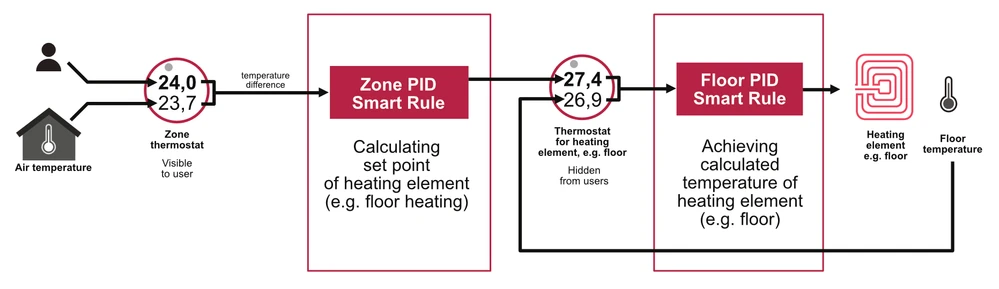
| Parameter | Zonal PID Smart rule | Floor PID Smart rule |
|---|---|---|
| Output actuator | Thermostat for the heating element 0% … 19 ºC 100% … 28 ºC | Switch (relay), 15-minute switching period |
| Limit temperature | Optional: 10 ºC - 30 ºC (default), adjustable in the zone thermostat service settings | Optional: Floor temperature sensor, max. temperature 28 ºC |
The maximum floor temperature allowed by hygienic standards is 28 ºC. However, for heating purposes it is possible to use a few degrees more (e.g. 36 ºC), because the sensor measures the temperature beneath the floor surface.