
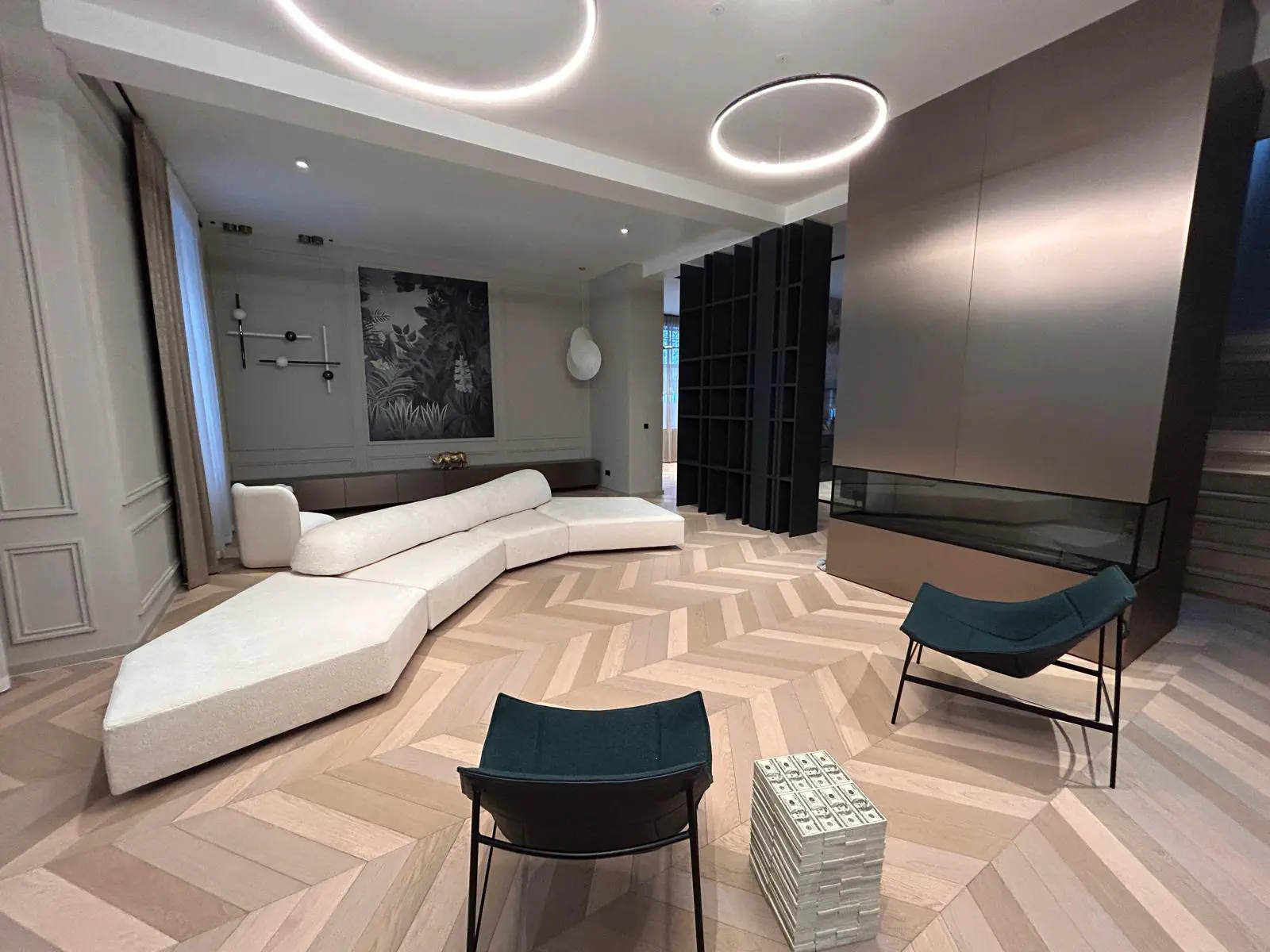
Luxury House in Budapest, Hungary
A friend’s recommendation was all it took. When the owner of this 310 m² Budapest residence saw what TapHome could do in a home he already knew, the decision was made. The challenge: retrofitting a classical three-storey building with modern smart home technology while adding a bold glass extension for the dining area.
Two distribution cabinets, 10 rooms across three levels, and one unified system that controls everything from 58 individually dimmable ceiling lights to sauna temperature in the basement.
58 fixtures, one system
The lighting design defines this home. Fifty-eight DALI-controlled fixtures are organized into 7 groups with 3 programmable scenes — dinner, TV, various moods. A single “leave home” button turns everything off at once.
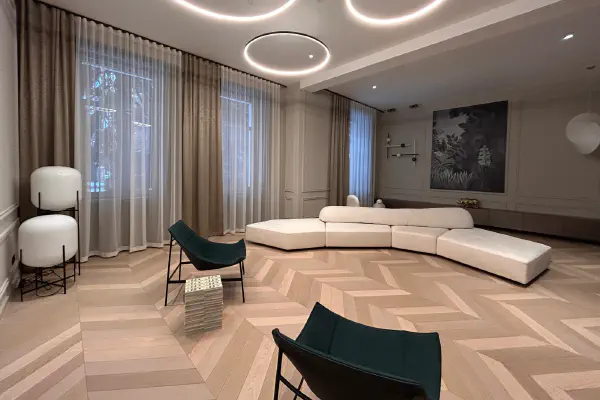
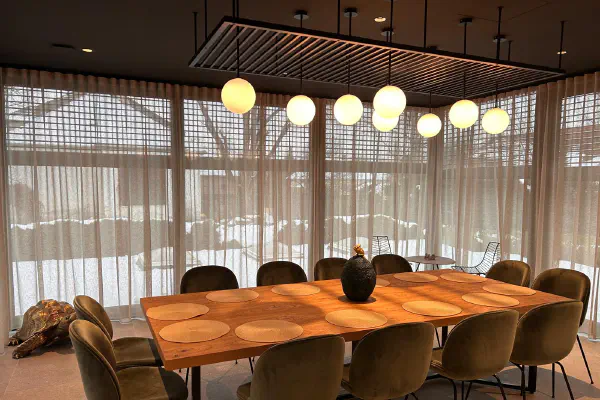
The variety is striking: circular ring LEDs suspended over the living room, globe pendants above the dining table, a sculptural branching fixture in the hallway, and playful decorative wall sconces throughout. Each type serves a different purpose, but all answer to the same control system through a DALI Resi Gateway.

Fifteen TapHome Smart switches (5-button and 6-button variants) handle daily control throughout the home. For the bedrooms, Niko push buttons were installed beside the beds — chosen specifically for their tactile micro-switch feedback that makes them easy to find and operate in the dark.

The range of fixtures — from clean minimalist rings to a whimsical ceramic toucan holding a warm Edison bulb in its beak — captures the personality of this home. Eclectic taste, unified control.
Dining in glass, protected by automation
The most distinctive feature of the renovation is the glass extension — built as a winter garden, now the primary dining area. Floor-to-ceiling windows on three sides flood the space with light but create an obvious challenge: intense solar gain in summer, heat loss in winter.
Six motorized shutters solve both problems. They respond automatically to weather and light conditions during the day and close after dark. The dining area has its own electric underfloor heating with floor temperature monitoring — a separate system from the original building, required by the different foundation of the addition.
Where old meets new
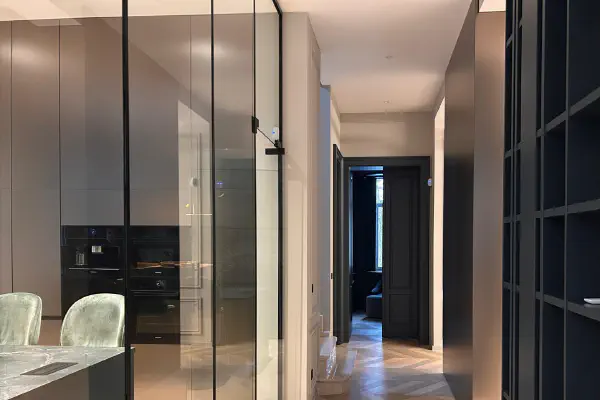
The hallway connecting the original building to the kitchen and living areas reveals the architectural language of the renovation: herringbone parquet flowing continuously through every room, floor-to-ceiling glass partitions, dark built-in cabinetry with clean geometric lines, and premium Miele appliances integrated behind smoked glass.
Classical mouldings of the original structure meet modern dark-toned additions. The contrast creates a distinctive character — refined but not cold.
Three zones, three levels
The heating system reflects the building’s history. Radiators where the original structure dictated, underfloor heating where the renovation allowed. Three zones — one per level — each monitored by a multi-function controller that measures both humidity and temperature, automatically regulating the climate for that floor.
Cooling was not needed. The motorized shutters on the glass extension handle solar gain, and the building’s thermal mass keeps temperatures comfortable year-round.
Sauna under smart control
The basement wellness area includes a sauna whose lighting and temperature are integrated into the same system that manages the rest of the house. One app, one interface — from the living room lights to the sauna heat.
The renovation challenge
This project stands out as a retrofit. Two distribution cabinets serve the entire system: one in the basement handles the original wiring, while a second on the ground floor manages both the ground and upper floors. All TapHome modules are distributed across these two cabinets, operating as one unified system.
“I really enjoyed this project because it’s always a new challenge — doing something where you have to convert an existing system, rewire it, and hopefully it will work well too.”
— Architechnik


